Part of the Backlink Indexing topic guide. Use the guide to move from this specific question to the full diagnostic workflow.
A backlink-type label does not determine indexing. Evaluate the source page’s availability, discovery paths, rendered purpose, directives, canonical behavior and dated index observations. The categories below are a triage hypothesis only; IndexVero does not claim a measured success rate by backlink type. For blog comments, the original article URL may already be indexed, but a #comment fragment is not a separate URL for Google to index.
Link type is only a triage label inside the backlink indexing and verification system; source-page evidence determines the operational decision.
Ranked by indexing difficulty (hypothesis, not measured)
The ordering below is a prioritization hypothesis based on source-page behavior, not a measured index-rate benchmark. IndexVero does not currently store a verified backlink-type field, so no per-type success rate is claimed here.
| Link type | Indexing difficulty | Why | How to handle |
|---|---|---|---|
| Editorial guest post (strong site) | Easy | High authority, crawled often | Usually self-indexes; just wait |
| Forum thread with traffic | Easy–Medium | “Alive” page Google visits | Pick active threads; little needed |
| Established Web 2.0 platform (Google Sites, Blogger, WordPress.com) | Easy | Large platforms are trusted, receive traffic, and are crawled frequently | Publish a useful public page with original content |
| Automated Web 2.0 blog (RankerX, SEO Autopilot, similar tools) | Very hard | Mass-created sites often have thin content, automation footprints, and few real signals | Rebuild with unique content and genuine links, or skip low-value properties |
| New or clean PBN | Easy | A new property without a spam history can initially be crawled and indexed normally | Keep pages useful and avoid rapidly publishing large volumes of thin content |
| Aged or overused PBN with many spam URLs | Hard / high risk | Heavy URL and outbound-link spam can erode trust and lead to deindexing or penalties | Audit its history and index status; avoid properties that show penalty or deindexing signals |
| Citation / directory | Hard | Many directory pages have been heavily spammed and provide little unique value | Use only selective, reputable directories; avoid mass submissions |
| Blog comment | Source page: usually indexed | The original article URL may already be indexed, but the #comment fragment is not a separate indexable URL | Check the article URL, not the comment anchor |
| Social profile | Easy | Established social platforms have traffic and are crawled frequently | Use a complete, public profile and keep it active |
| Google Chrome / Chrome Web Store listing | Medium | Store pages are authoritative, but crawl and indexing can vary by listing quality and demand | Complete the public listing, add unique copy, and earn relevant mentions |
| Mozilla Firefox Add-ons listing | Hard | Smaller ecosystem and lower discovery demand can mean slower, less reliable indexing | Build a complete listing and link to it from relevant, crawlable pages |
| Podcast link | Medium | Indexing depends on the podcast platform and the quality of the episode or show-notes page | Prefer established podcasts with public, detailed show notes |
Replace “link type” guesses with observable gates
| Gate | What a provider can verify | What it does not prove |
|---|---|---|
| Availability | The source URL returns a usable response at the check time | That Google crawled or indexed it |
| Link delivery | The expected target and anchor are present in the rendered source page | That the link transfers ranking value |
| Index eligibility | No obvious noindex, blocking, canonical, or access conflict is visible | That Google will select the page |
| Dated observation | The exact URL or an alternate/canonical form was observed at a stated time | A permanent state or a guaranteed ranking effect |
Provider decision rule: use link type as a cohort label, not as the verdict. Prioritize a cohort only after its source pages pass availability and link-delivery checks, then compare dated observation rates using the same denominator and window. Until that benchmark exists, the difficulty order above remains a hypothesis rather than a product promise.
How to spend indexing budget
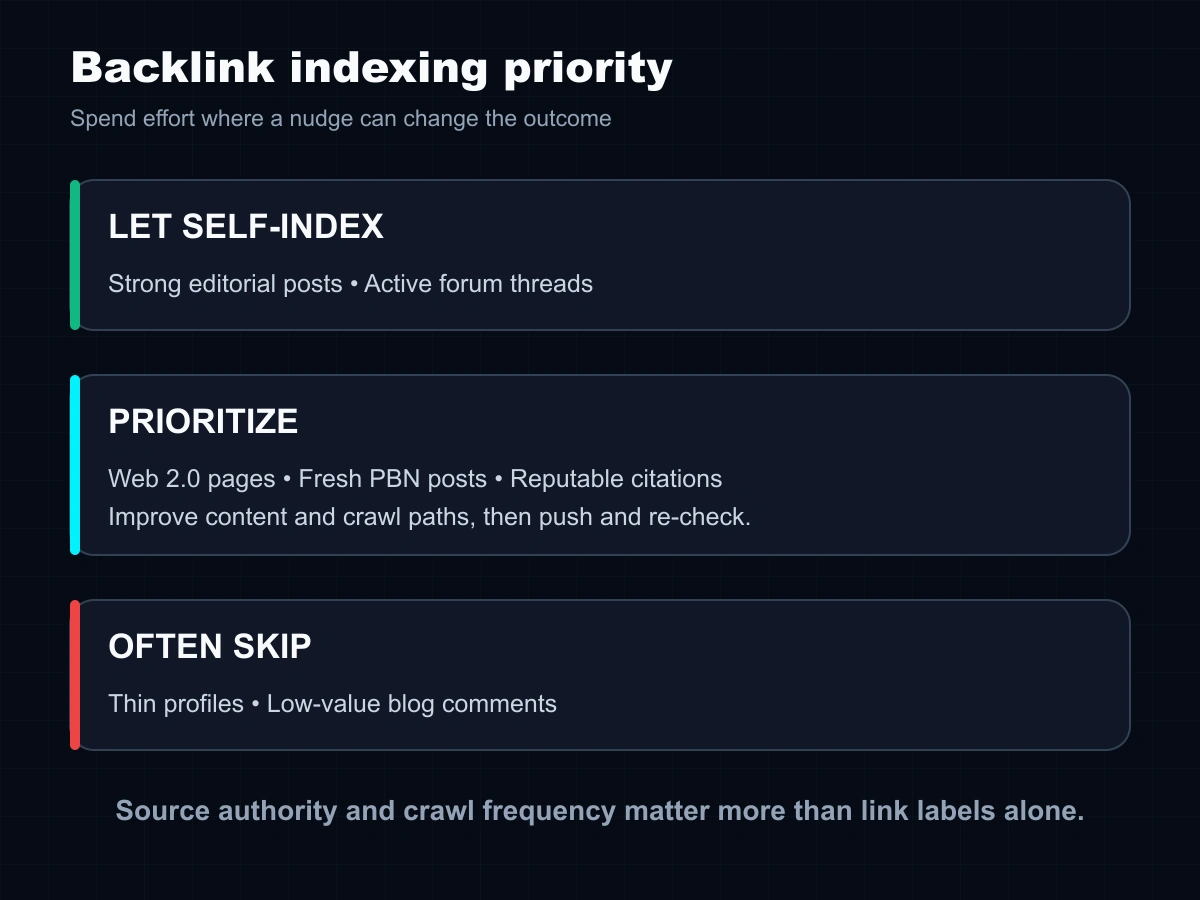
- Don’t spread credits evenly. Strong editorial links, active forum threads, genuine social profiles, and useful pages on established Web 2.0 platforms often self-index. Save credits for pages where one nudge can make a difference.
- Cut the lowest tier. Automated Web 2.0 properties, mass-submitted directory links, and thin spam pages tend to index less reliably in practice (an operational rule of thumb, not a measured rate). For blog comments, evaluate the indexed article URL rather than trying to index a
#commentfragment.
Use these source-page gates alongside explicit indexer selection criteria before allocating budget to a provider.
A simple workflow
- Check the whole batch’s index status → split into indexed vs not.
- For the not-indexed group, look at the link type above to decide save vs skip.
- Push the ones worth saving into the index; re-check after a few days.
Why source authority beats everything
Two identical anchors on two different sites can behave completely differently: the one on a strong, frequently crawled domain indexes fast, while the one on an overused PBN with a long spam history may remain unindexed or disappear from the index. A new clean PBN can index more easily at first, but publishing too many thin or spammy URLs can quickly erode that advantage. Evaluate crawl frequency, content depth, index history, and spam footprint together.
How to build a real link-type benchmark
The current IndexVero aggregate does not store a verified backlink-type field, so it cannot support index-rate claims for PBNs, guest posts, profiles or citations. Treat the qualitative ordering above as a prioritization hypothesis.
A publishable benchmark must predefine type labels, source ownership, HTTP availability, canonical form, content class, submission date, observation method and recheck windows. Report unknown/mixed types instead of inferring type from a domain name.
How should a provider turn link type into a purchase decision?
Use link type as a routing label, not as proof of indexability. Before a backlink seller accepts, replaces or spends additional budget on a placement, score the observable source-page gates.
| Decision gate | Acceptable evidence | Buyer action |
|---|---|---|
| Contract match | Promised type, target, anchor and attributes are present | Reject mismatches before indexing work |
| Availability | Stable final response and expected document | Escalate access errors separately |
| Discovery structure | Crawlable internal path or declared listing route | Prefer placements with durable discovery paths |
| Page purpose | A useful page that exists beyond the outbound placement | Avoid thin inventory created only to host links |
| Dated observation | Exact, alternate/canonical, not observed or unavailable | Report the evidence class, not a type-based promise |
Buyer-proof boundary: a “guest post,” “directory” or “profile” label does not establish the source response, link presence or indexed representation. Connect this triage to the Backlink Indexing hub, delivery QC, tracking and the public methodology.
FAQ
Which link type should I avoid if I need indexing?
Automated Web 2.0 properties, mass-submitted directory links, and backlinks on thin spam pages. A blog comment’s #comment fragment is not a separate URL to index, while a genuine public social profile is often crawled naturally.
Do citations index?
Reputable citations can index, but mass-submitted directory pages are increasingly difficult because many have been heavily spammed. Choose selective directories and verify NAP consistency so the citation is genuinely useful.
Can nofollow links be indexed?
Yes — index status is independent of rel; what matters is the source page’s value.