Part of the Backlink Indexing topic guide. Use the guide to move from this specific question to the full diagnostic workflow.
Don’t index once and forget. Index status changes over time — indexed links can drop, and unindexed ones can come in. The fix: check your batch’s index status on a schedule, log the status by date, and compute a real index rate so you know the true quality of a link package.
Dated transitions are the measurement layer of the backlink indexing evidence workflow, connecting delivery records to later client proof.
Why you have to track continuously
- Links fall out of the index when the source page loses value or gets removed.
- Links newly index after Google re-crawls.
- For a sold package, report a dated series with the same cohort and method; one current snapshot cannot show stability or causation.
When authorized Search Console evidence shows Crawled – currently not indexed, keep that property-level state separate from the public observation timeline.
The tracking workflow
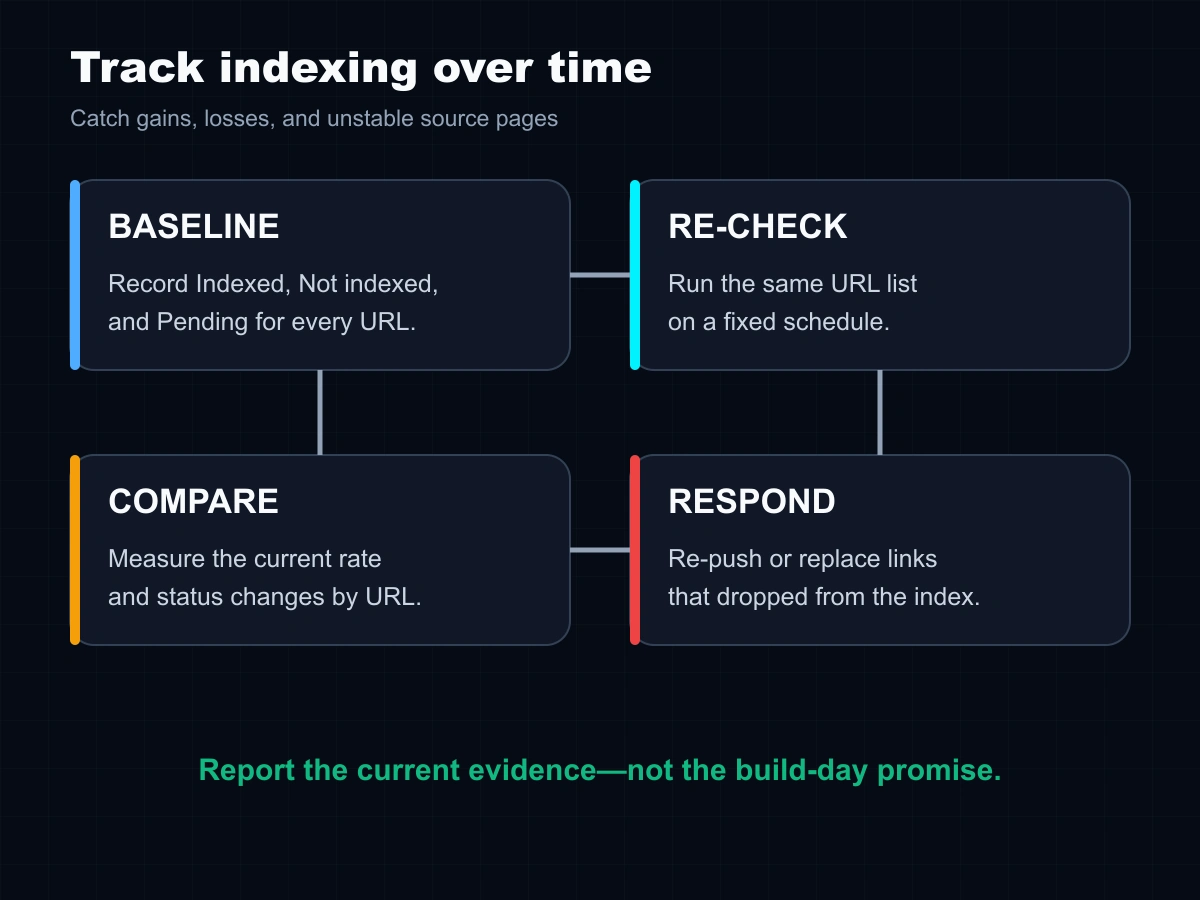
- Baseline: right after building, check the batch and record Indexed / Not / Pending.
- At a defined decision interval: recheck the same frozen list with the same method and compare it with baseline.
- Compute comparable rates: keep exact, alternate/canonical, not-observed and unavailable results separate; exclude unavailable checks from observed-result denominators.
- Investigate transitions: when an exact observation becomes not observed, first recheck the source response, URL form, link presence and observation method before choosing repair, replacement or another check.
How to log it
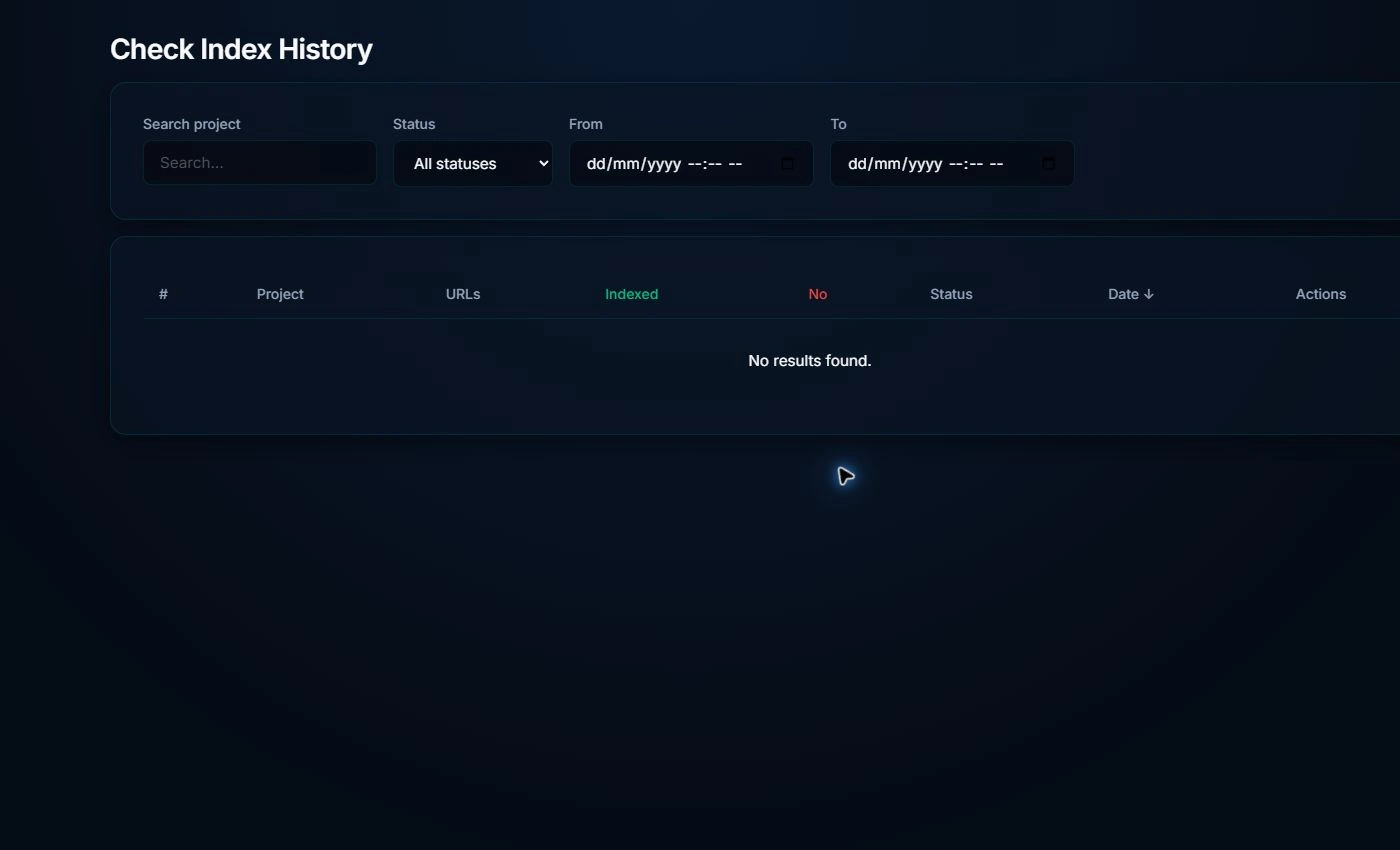
- A table of URL × date (status each check) shows which links are unstable.
- Export a client report per date, with the real index rate.
Tie it to sign-off
A real index rate plus a tracking history is transparent evidence for payment — instead of a 100% promise. Need to push the not-indexed portion? Index them and keep tracking. (See proving index rate to clients.)
Why one check is not enough
A URL’s observed status is not stable. Some URLs first recorded as not observed indexed are recorded as indexed on a later check, and some URLs recorded as indexed are later not observed. A single snapshot therefore describes one moment, not the outcome of a campaign.
The defensible metric is therefore a transition:
URL + method + time₁ + verdict₁ → time₂ + verdict₂, not a permanent
label. These transitions are observational and do not establish causation.
The IndexVero measurement methodology defines these dated transitions and explains why campaign processing, an index observation and causation are separate claims.
If recheck history is a buying requirement, review the Rapid URL Indexer comparison and compare what each workflow actually records.
How should a provider calculate a comparable transition rate?
Freeze the cohort and preserve every observation class. Do not put unavailable checks into either the indexed or not-observed bucket.
| Field | Definition | Why it matters |
|---|---|---|
| Eligible cohort | Deduplicated source URLs included at baseline | Prevents denominator drift |
| Comparable checks | URLs with a usable result at both observation times | Separates evidence from tool/network failure |
| Exact observation rate | Exact indexed observations ÷ comparable checks | Keeps the URL-form rule explicit |
| Alternate/canonical rate | Alternate observations ÷ comparable checks | Avoids hiding canonical movement |
| Transition rate | Named state change ÷ URLs eligible for that transition | Measures change without claiming causation |
Example: if 100 URLs enter a recheck and 8 checks are unavailable, the observed-rate denominator is 92—not 100. Report the 8 unavailable separately and keep the same method when comparing campaigns.
This evidence object gives a client or buyer a reproducible history while keeping private processing logic undisclosed. Route broken or redirected sources to availability QC, and use the Backlink Indexing hub for the full workflow.
FAQ
How often should I track?
Choose a recheck interval from the operational decision or delivery agreement, and keep the method and interval consistent when comparing cohorts.
What index rate is “good”?
There’s no absolute number — what matters is that it’s real, transparent, and trending steadily.
Why did an indexed link disappear?
The transition does not identify one cause. Recheck availability, redirects, link presence, canonical URL form and method consistency before choosing an action.