Part of the Backlink Indexing topic guide. Use the guide to move from this specific question to the full diagnostic workflow.
NAP consistency means that each citation represents the intended business or location with accurate Name, Address and Phone data. The practical problem is entity resolution, not punctuation: “Street” versus “St.” can be an equivalent formatting variant, while an old phone number or another location’s address is a material conflict. Citation providers should compare every delivery against an approved master record and report unresolved pages separately.
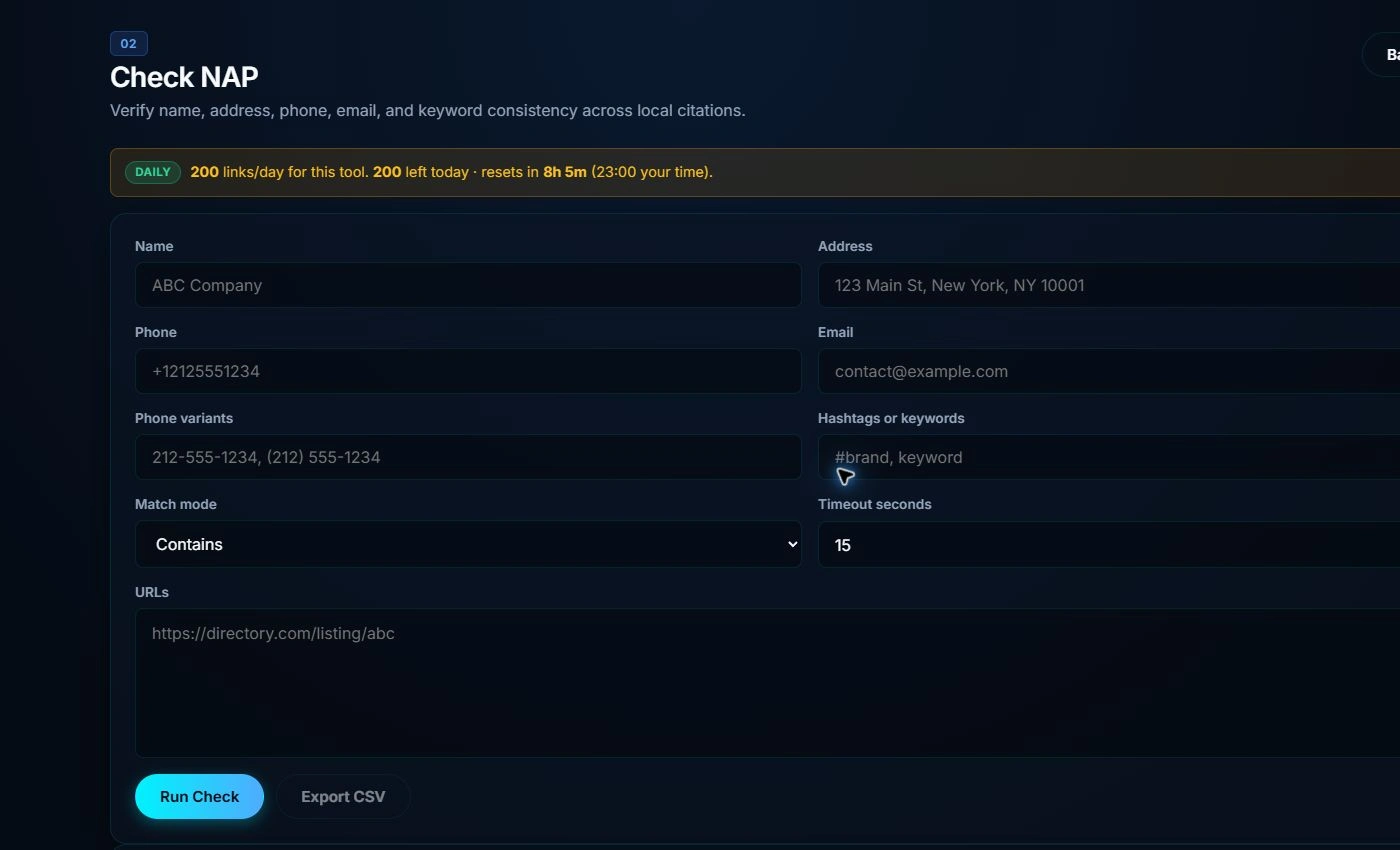
This guide is part of the backlink-indexing and delivery evidence library. Use the IndexVero NAP Checker when a citation batch needs a repeatable field-by-field comparison.
What is a master NAP record?
A master record is the approved identity for one business location at a stated time. It should not be a loose string copied from whichever directory appears first.
| Field | Master value should record | Common ambiguity |
|---|---|---|
| Business name | Real-world name and approved legal/brand variation | Suffixes, departments, practitioner names or keyword additions |
| Address | Structured street, unit, locality, region, postal code and country | Abbreviations, suite placement, former locations or service areas |
| Phone | Country code and location-specific callable number | Old numbers, tracking numbers or a central call center |
| Location identity | One stable internal location ID | Two branches sharing a brand name |
| Effective date | When the approved record became valid | A directory captured before a legitimate move or rebrand |
Google Business Profile guidance asks businesses to represent themselves consistently as recognized in the real world, use an accurate address or service area, and provide a phone number that connects to the individual location. See Google’s business representation guidelines. Documentation last checked: August 2, 2026.
Which NAP differences are material?
| Observed difference | Entity interpretation | Delivery class |
|---|---|---|
Street versus St.; casing or punctuation only | Usually the same normalized value | Formatting-equivalent |
| Suite omitted but street and business remain unambiguous | Potentially incomplete; assess the location and directory format | Review |
| Old phone number or unreachable number | Material contact conflict | Correct before sign-off |
| Address belongs to another branch | Wrong location entity | Conflict |
| Keyword-stuffed name not used by the business | Representation differs from the approved entity | Conflict or policy review |
| Directory page cannot be reached or read | No reliable comparison can be completed | Unverifiable |
Do not force every field through raw exact-string equality. Normalize presentation differences first, then preserve the original observed value beside the normalized value so the decision can be audited.
A citation-delivery evidence model
approved location entity → master NAP version → delivered citation URL → observed fields → normalized comparison → delivery verdict → dated index observation
Each arrow answers a different question. A citation can match the master record but remain unavailable to a public index check. A source page can be observed indexed while displaying the wrong phone number. Neither result should overwrite the other.
How should backlink sellers verify a citation batch?
- Freeze the approved input. Obtain the client-approved business name, structured address, phone, location ID and effective date before production.
- Preserve every delivered URL. Do not replace a source URL with its domain or redirect target in the raw delivery list.
- Fetch and record the final page. Keep the response class, final URL and check time. Unavailable pages do not enter the verified denominator.
- Extract the visible fields. Record what the citation actually displays, not only what was submitted to the directory.
- Normalize before comparing. Standardize casing, whitespace, phone formatting and address components without erasing the original values.
- Classify the difference. Use consistent, normalized variant, material conflict or unverifiable.
- Correct and recheck. Treat the later observation as a new event rather than rewriting the failed check.
A delivery matrix for providers
| Observed record | Provider action | Client handoff |
|---|---|---|
| Name, address and phone match the approved master record | Accept | Source URL, observed values and check date |
| Formatting differs but the same entity is unambiguous | Accept as normalized variant when the agreement permits it | Original and normalized values plus the comparison rule |
| A material field points to another entity, location or phone | Correct or replace | Conflict field, correction request and recheck state |
| Listing is unavailable, gated or unreadable | Hold outside verified delivery | Unavailable reason and next review date |
What should the evidence export contain?
- client or cohort ID and location ID;
- master NAP version and effective date;
- requested URL, final URL and response class;
- observed name, address and phone;
- normalized values and comparison rule;
- field-level verdict and overall delivery class;
- check timestamp, recheck timestamp and correction status.
This format makes a seller’s sign-off reproducible without claiming access to a search engine’s private entity systems. Use the outsourced backlink QC workflow for the broader delivery audit.
Use the client-facing evidence export workflow when the handoff also includes dated index observations and a cohort rate.
How does NAP verification relate to indexing?
NAP correctness and source-page indexing are separate attributes. First verify that the public citation displays the approved business details. Then use the dated backlink-indexing workflow when the contract also requires an index observation.
The IndexVero measurement methodology keeps delivery verification, unavailable checks, exact observations and alternate/canonical observations separate. A correct NAP record does not guarantee indexing, ranking or visibility; an index observation does not prove the business details are correct.
FAQ
Does “St.” versus “Street” make a citation wrong?
Not automatically. Normalize the address components and verify that both values resolve to the same business location. Preserve the original display value in the audit.
Should a tracking phone number always fail?
Not automatically. Compare it with the client’s approved policy and the location-specific number. Mark it as a review item when ownership, routing or intended use is unclear.
Does consistent NAP guarantee higher local rankings?
No. Accurate representation supports a clean business record and defensible citation delivery, but this workflow does not isolate or guarantee a ranking effect.
What happens when a directory page is unavailable?
Report it as unverifiable with the response class and time. Do not convert the failed fetch into a NAP mismatch or a not-indexed verdict.
Need the backlinks themselves crawled and indexed? Our backlink indexing service submits them in bulk and re-checks the result. Before choosing any tool, see how the best backlink indexers compare on refund terms and measured index rates.