Part of the Indexing Problems topic guide. Use the guide to move from this specific question to the full diagnostic workflow.
There is no universal deadline for how long Google takes to crawl or index a page. Some pages are indexed within hours, others take weeks, and pages Google judges low-value may never be indexed at all. The reliable approach is to measure the interval from a defined event — publication, submission or first discovery — to a dated observation, because the timeline depends on discovery, crawl budget, and whether the page earns a place in the index.
Elapsed time becomes actionable only after the current state is classified through the Indexing Problems evidence routes.
Why a universal indexing range is not defensible
Google publishes no fixed timeline and indexing is not guaranteed. A duration is meaningful only when its start event, URL cohort, observation method, URL-form rule and unavailable-result treatment are named. Track the evidence state instead of assigning a site to an unsupported “hours,” “days” or “weeks” promise.
Anchor the report in the definition of an indexed page before measuring elapsed time or comparing cohorts.
What affects how fast a page indexes
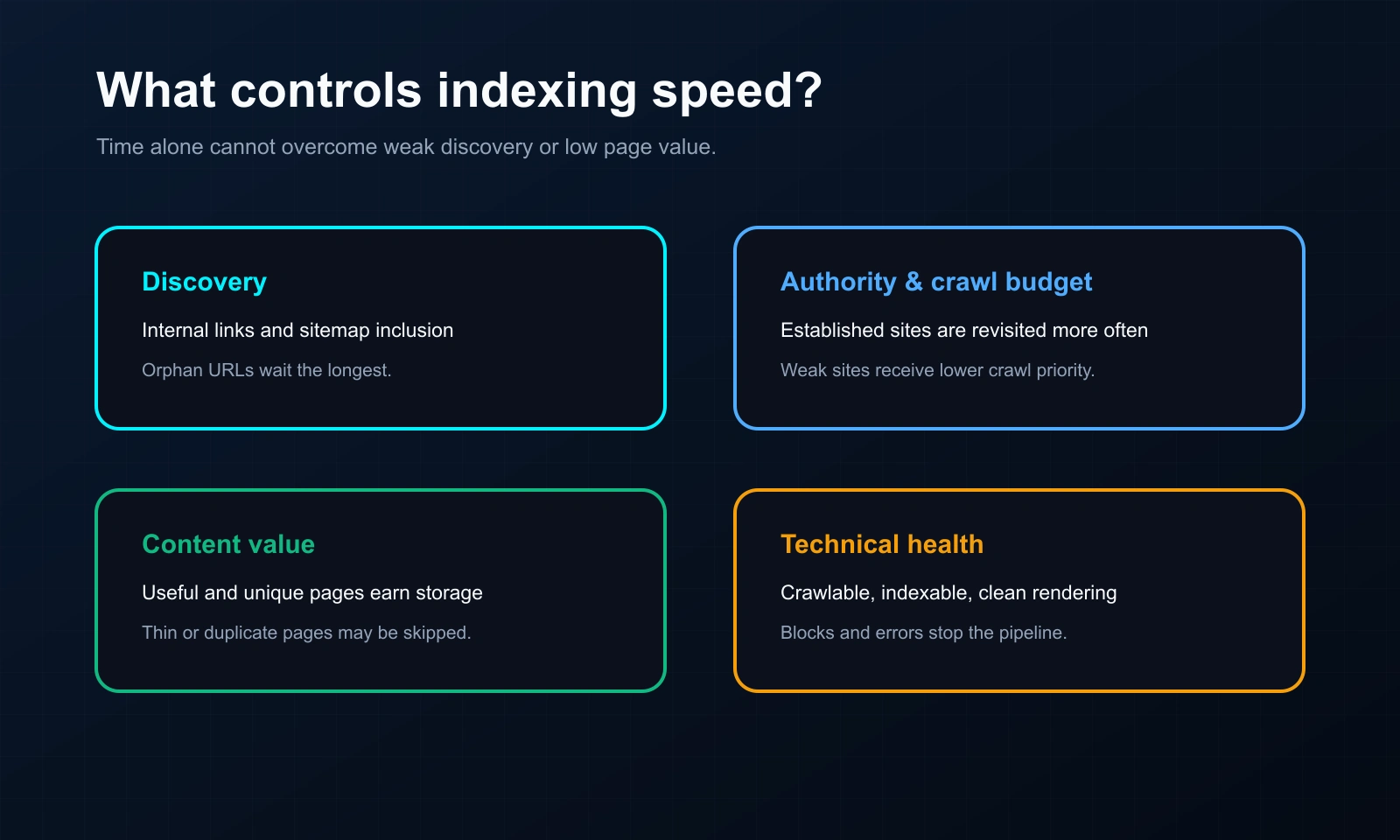
- Discovery — is the URL linked internally and in your sitemap? Orphan pages wait the longest.
- Crawl capacity and demand — host health, update patterns, inventory and demand affect scheduling; do not reduce them to one authority label.
- Representation and duplication — evaluate whether the page is distinct, complete and aligned with its canonical signals without promising faster indexing.
- Technical health — crawlable, no accidental noindex, renders cleanly.
Why some pages never index
Time isn’t the only variable. A page can remain in “Crawled—currently not indexed,” but the label alone does not identify one cause. Use the evidence-first diagnostic rather than converting elapsed time into a quality verdict.
How to speed it up
- Add internal links from strong pages and include the URL in your sitemap.
- Improve content so it’s clearly worth indexing.
- Use URL Inspection → Request Indexing after a fix (for your own pages).
- For backlinks or large batches, actively index the backlinks and track status.
What about backlinks?
Backlink indexing follows the same logic but hinges on the source page. Source pages differ in discovery, availability, content, directives and canonical behavior. Do not infer a private Search Console state or deadline from the source type; verify delivery and record a dated observation.
Why one check is not a deadline
Google does not publish a universal indexing deadline, and one check does not settle the question: a URL recorded as not observed indexed can be recorded as indexed on a later check, at intervals ranging from hours to days. That is why a dated recheck history, rather than a single snapshot, is the defensible way to report a batch.
These are observational transitions—not proof that waiting or submission caused indexing. Use them to justify dated rechecks, not to promise a deadline.
How should a backlink seller report elapsed time?
Providers should report elapsed time from a named event, not promise a universal Google deadline. A client row can preserve publication time, campaign-processing completion, first observation, recheck time and current evidence class without disclosing proprietary processing details.
| Clock | Starts at | Stops at | Allowed claim |
|---|---|---|---|
| Publication age | Source became publicly reachable | Current check | How long the delivered page has existed |
| Processing interval | Campaign accepted | Campaign processing completed | Operational duration only |
| Observation interval | First named index check | Later named check | How the observation changed over time |
| Owner evidence interval | Recorded crawl or request event | Later property-level state | Available only with authorized property evidence |
Client-handoff example: “Published July 1; delivery verified July 2; no exact indexed representation observed July 2; exact representation observed July 4.” This proves a transition, not that waiting or submission caused it.
Use the tracking owner for transitions and the IndexVero methodology for cohort denominators.
FAQ
How long should I wait before worrying?
There is no universal waiting threshold. Compare indexed data, a live test, last crawl, canonical signals and changes made since the last crawl.
Does Request Indexing make it instant?
No. The request does not guarantee crawling or indexing, and Google does not provide a universal completion time.
Why do new sites take longer?
New sites often have fewer discovery paths and less established crawl demand, so Google tends to schedule them less frequently. This is a general tendency, not a fixed rule for every site.