Part of the Indexing Basics topic guide. Use the guide to move from this specific question to the full diagnostic workflow.
Indexing is the process of a search engine storing and organizing a web page in its database so the page is eligible to appear in search results. A page that is not indexed is not eligible to surface as an indexed search result; that alone does not prove the page has zero value through other discovery, crawling or link-attribution effects. A page becomes indexed only after Google discovers it, crawls it, and decides it’s worth storing.
The definition of an indexed representation anchors the Indexing Basics entity map; crawling, canonicalization and ranking are related but separate states.
“Indexed” is the difference between a page that can win traffic and one that doesn’t exist as far as search is concerned. Here’s what that actually means, and how to tell whether your pages (and your backlinks) made it in.
Indexing in one sentence
When Google indexes a page, it analyzes the content — text, images, entities, links — and files it in a massive database (the index). When someone searches, Google pulls candidates from that index. No entry in the index, no chance of appearing.
The three stages: crawl → index → rank
Indexing is the middle step of a three-part pipeline. Mixing these up is the most common source of confusion:
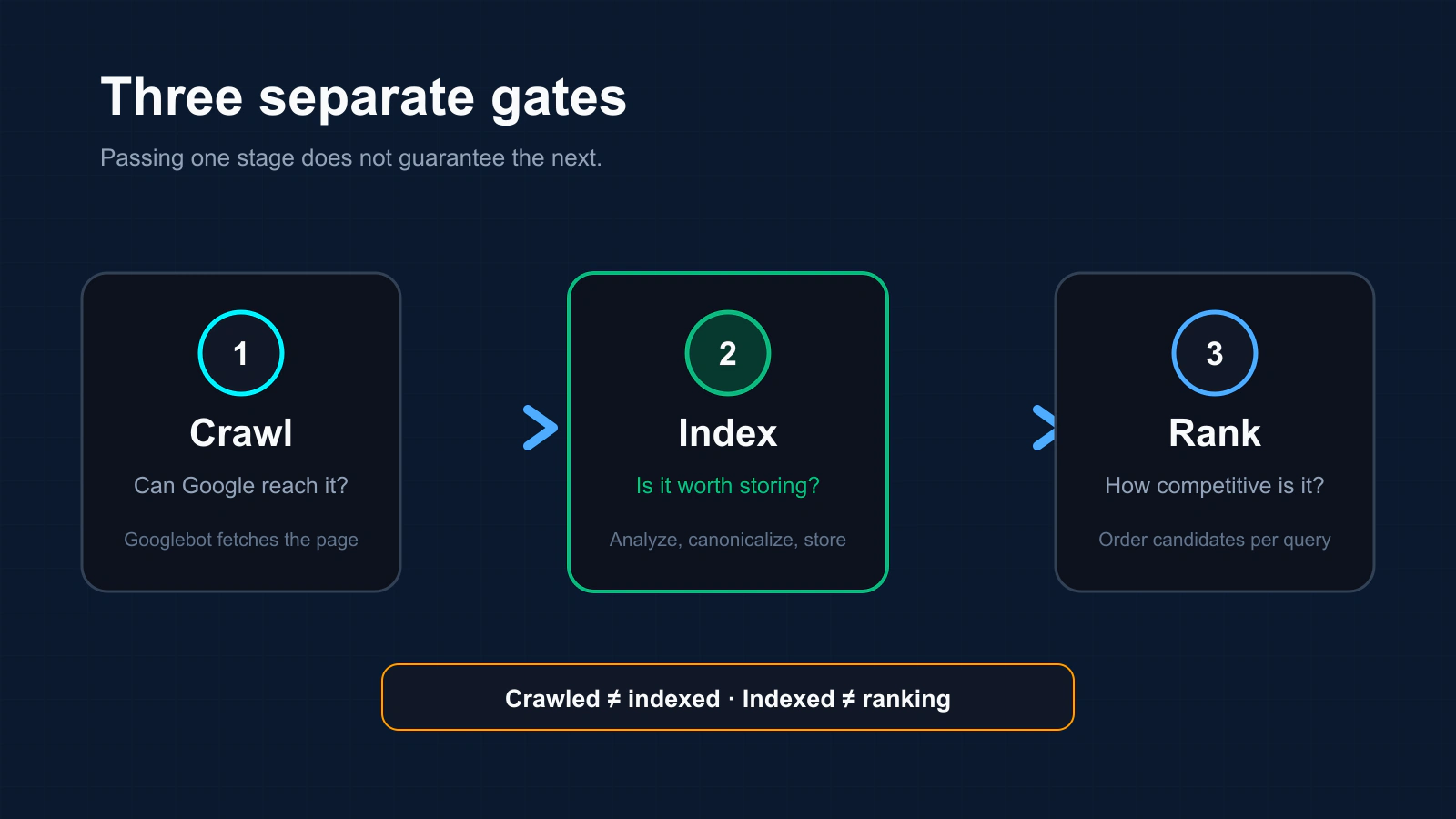
| Stage | What happens | Question it answers |
|---|---|---|
| Crawling | Googlebot fetches the page | Can Google reach it? |
| Indexing | Google analyzes and stores it | Is it worth keeping? |
| Ranking | Google orders indexed pages for a query | How good is it vs others? |
Crawled does not mean indexed, and indexed does not mean ranking. Each stage is a separate gate. (More on the first two in crawling vs indexing.)
How a page gets indexed
- Discovery — Google finds the URL through internal links, a sitemap, or links from other sites.
- Crawling — Googlebot fetches the page and renders it (including JavaScript).
- Indexing decision — Google evaluates quality, uniqueness, and canonicalization, then stores the page if it sees enough value.
That third step is not guaranteed. A fetched URL can remain outside the index because of directives, canonical selection, duplication, rendering, response behavior or other indexing decisions; the recorded evidence determines the next investigation.
Why some pages never get indexed
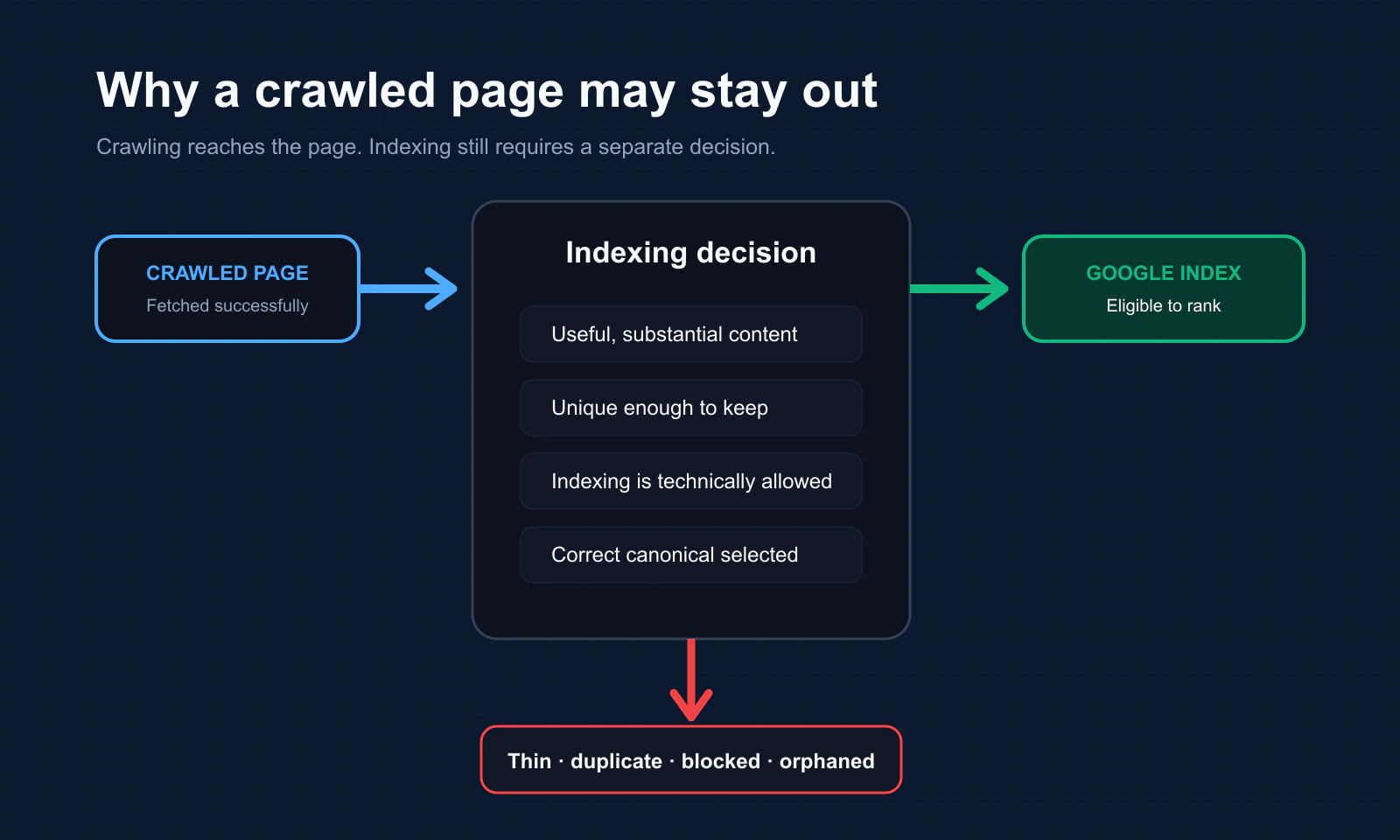
- Low value or thin content — the most common reason a crawled page is excluded.
- Duplicate content — Google keeps one canonical version and drops the rest.
- Technical blocks — a
noindextag or robots.txt rule. - Discovery or crawl constraints — weak internal paths, unstable responses or limited crawl activity can delay processing.
- Not discovered yet — orphan pages with no links or sitemap entry.
For a full diagnostic, see why a page isn’t indexed.
To connect the definition to property-level evidence, understand index coverage in Search Console and keep its recorded status separate from an external observation.
Why indexing matters for backlinks
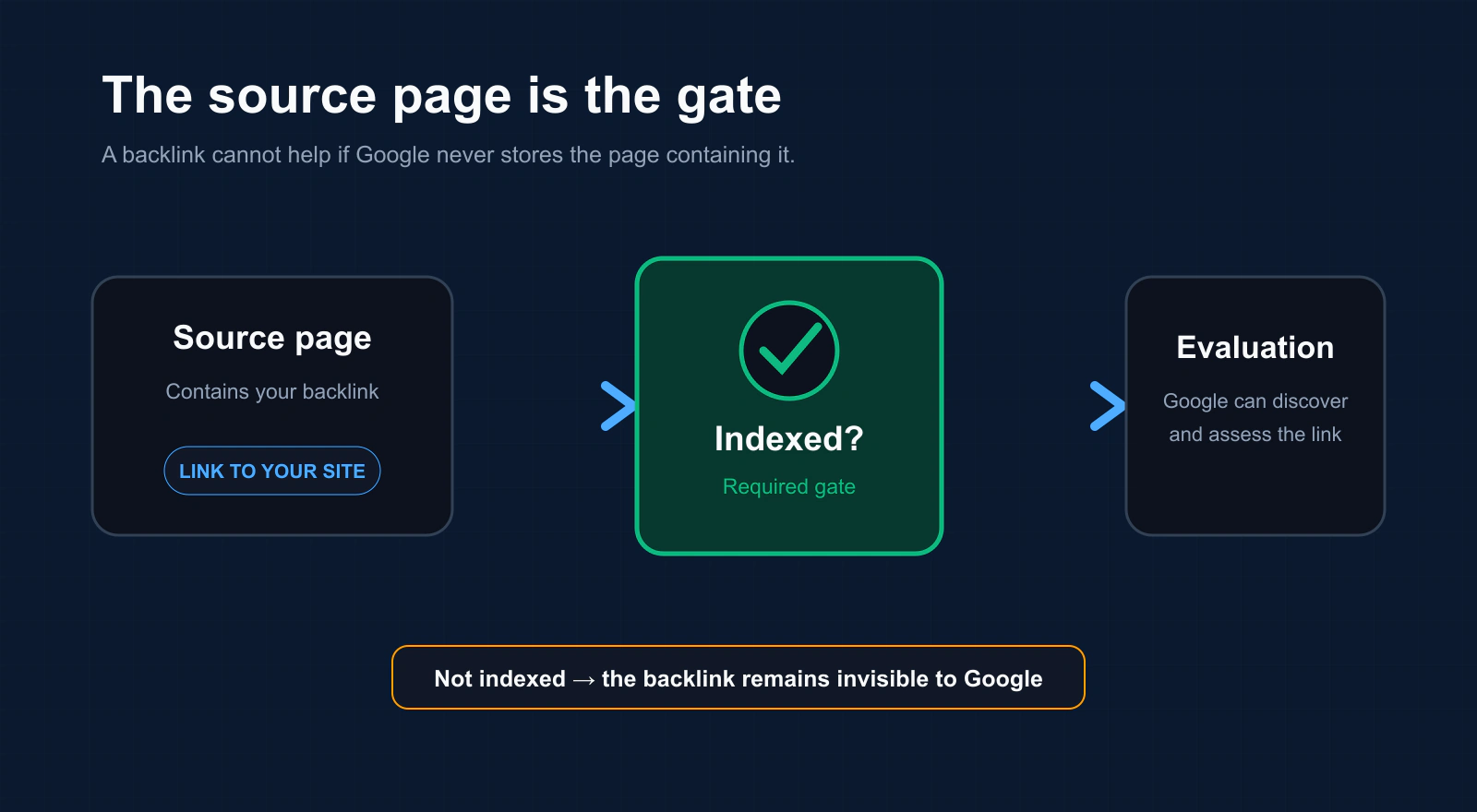
This is the part most “what is indexing” guides skip. A backlink can only be verified as an indexed search result once the page hosting it is indexed; if that page isn’t indexed, you can’t confirm the link is contributing — though that alone doesn’t prove its value is zero. Build a hundred links on pages Google never indexes and most can’t be verified, so you can’t demonstrate their value. That’s why anyone doing link building needs to verify indexation, not assume it. (See why backlinks don’t get indexed.)
How to check if a page is indexed
- Search operator:
site:yourdomain.com/page— quick but unreliable for a definitive answer. - URL Inspection tool in Search Console — accurate, but only for your verified property and one URL at a time (see the URL Inspection guide).
- Bulk index checker — for many URLs at once, or for backlinks on sites you don’t own: check indexation in bulk.
Indexing as an entity-state model
Indexing is not a property you infer from one signal. Model:
URL → fetched representation → rendered content → canonical cluster →
selected indexed representation
. Then attach a dated observation from
Search Console indexed data or a named external method. “Indexed” means stored
and eligible for search systems; it does not guarantee ranking or appearance for
a particular query.
What does “indexed” mean in a provider report?
For a backlink provider or seller, “indexed” should describe a dated observation about the source page—not a permanent property of the backlink and not proof of ranking impact. Keep the placement entity and the index-observation entity separate.
| Delivery field | What it establishes | What it does not establish |
|---|---|---|
| Source URL reachable | The page returned a usable response at check time | That the contracted link exists or is indexed |
| Expected link present | The target and anchor were observed in the page representation | That Google stores that representation |
| Indexed representation observed | The named method observed an indexed URL form at that time | A permanent state, a private Search Console reason or ranking contribution |
| Observation unavailable | The method produced no defensible result | A negative index verdict |
Provider rule: report submitted → published → reachable → link verified → dated index observation → recheck as distinct states. This lets a buyer see which obligation was delivered and which outcome remains controlled by Google.
For batch handoff fields, continue to backlink delivery QC. The public methodology explains why an observation does not prove causation.
FAQ
What does “indexed” mean?
It means Google has stored the page in its index and it’s eligible to appear in search results (eligible, not guaranteed to rank).
Is crawling the same as indexing?
No. Crawling is fetching the page; indexing is deciding to store it. A page can be crawled but not indexed.
How long does indexing take?
There is no universal indexing time. Google does not guarantee that any page will be indexed or state a fixed timeframe; some pages are indexed quickly, others slowly, and thin or duplicate pages may never be indexed. See how long indexing takes.
Do all pages get indexed?
No. Indexing is not guaranteed; directives, response behavior, canonical selection, duplication and other processing decisions can keep a URL outside the index.
If the URLs you need indexed are backlinks on sites you don’t control, Search Console can’t submit them for you. Our backlink indexing service handles third-party URLs in bulk and verifies the outcome.