Part of the Indexing Basics topic guide. Use the guide to move from this specific question to the full diagnostic workflow.
Google Search processes URLs through connected but distinct stages: discovery, crawl scheduling and fetching, rendering, indexing and canonical selection, then serving for a query. A URL can stop, wait or be represented by another canonical form at different points. The operational rule is to identify the stage supported by evidence instead of treating every missing result as one generic “indexing problem.”
The complete entity sequence is routed through the Google indexing fundamentals hub, with narrower owners for definitions, Search Console and URL Inspection.
The indexing pipeline, step by step
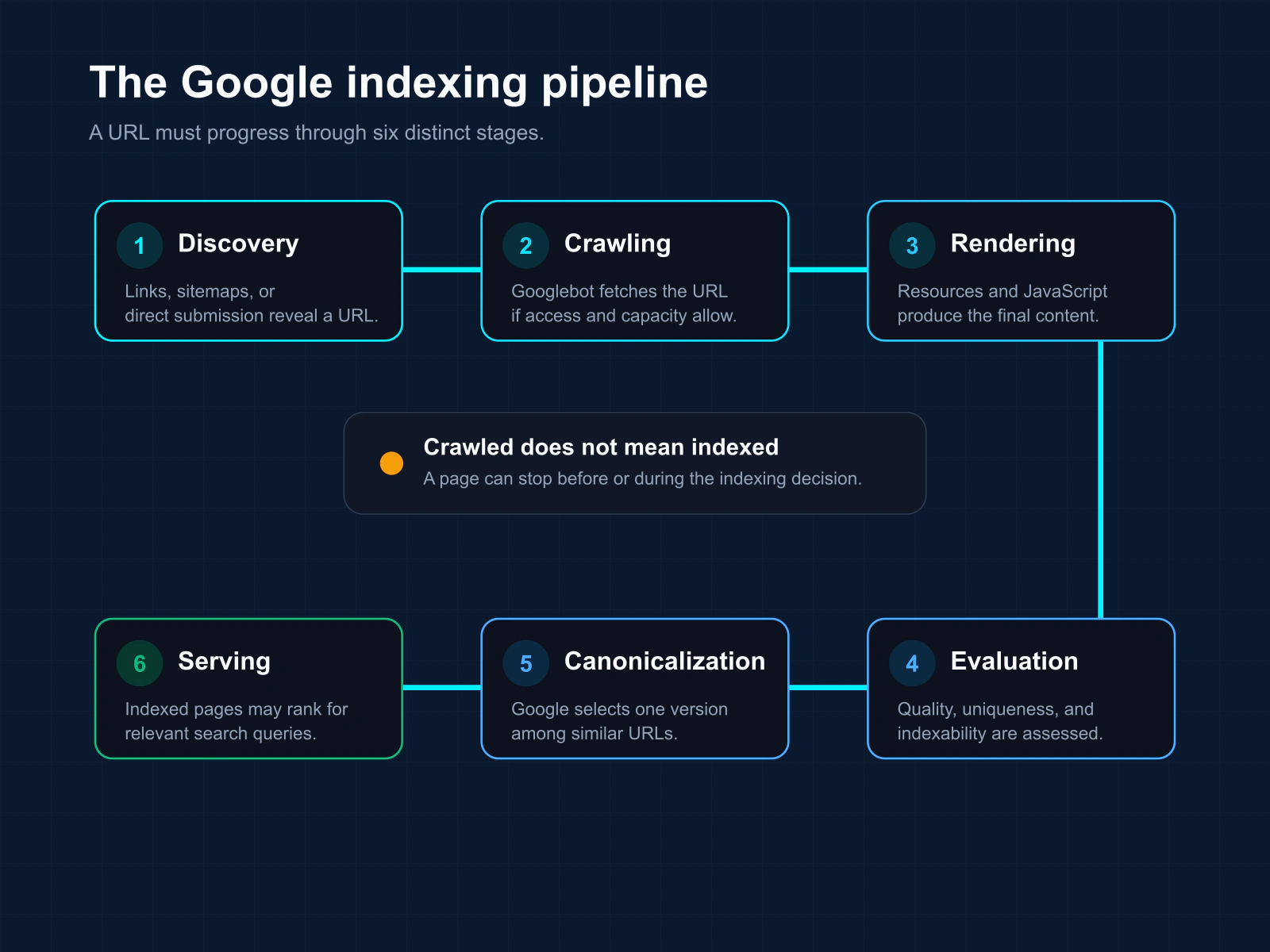
1. Discovery
Google can’t index a page it doesn’t know exists. It discovers URLs through:
- Links — internal links and links from other sites (this is how most backlinks get found).
- Sitemaps — an XML sitemap you submit or reference in robots.txt.
- Direct submission — Request Indexing in Search Console for a single URL.
2. Crawling
Googlebot schedules and fetches URLs within crawl capacity and crawl demand. Host health, response time, known URL inventory, update patterns, popularity and page relevance can affect crawling. A robots.txt rule can prevent fetching, while server errors or rate limits can reduce successful access.
3. Rendering
Google renders the page like a browser, executing JavaScript to see the final content. Content that only appears after JS can be missed if resources are blocked or rendering fails — a common hidden cause of non-indexing.
4. The indexing decision
Google analyzes the rendered content and other signals to decide whether and how the page belongs in the index. A completed crawl does not guarantee selection. Content usefulness, uniqueness, duplication, directives and canonical relationships may all be relevant, but a generic “not indexed” observation does not identify one cause by itself.
5. Canonicalization
Google can group duplicate or similar URL representations and select a canonical representative. Alternate URLs are not necessarily stored or served as separate indexed representations. A declared canonical is a hint, so Google may select a different representative when other signals conflict.
6. Serving
Indexed pages become candidates that Google ranks and serves for relevant queries. Being indexed is the entry ticket; ranking is a separate contest.
What makes a page more likely to be indexed
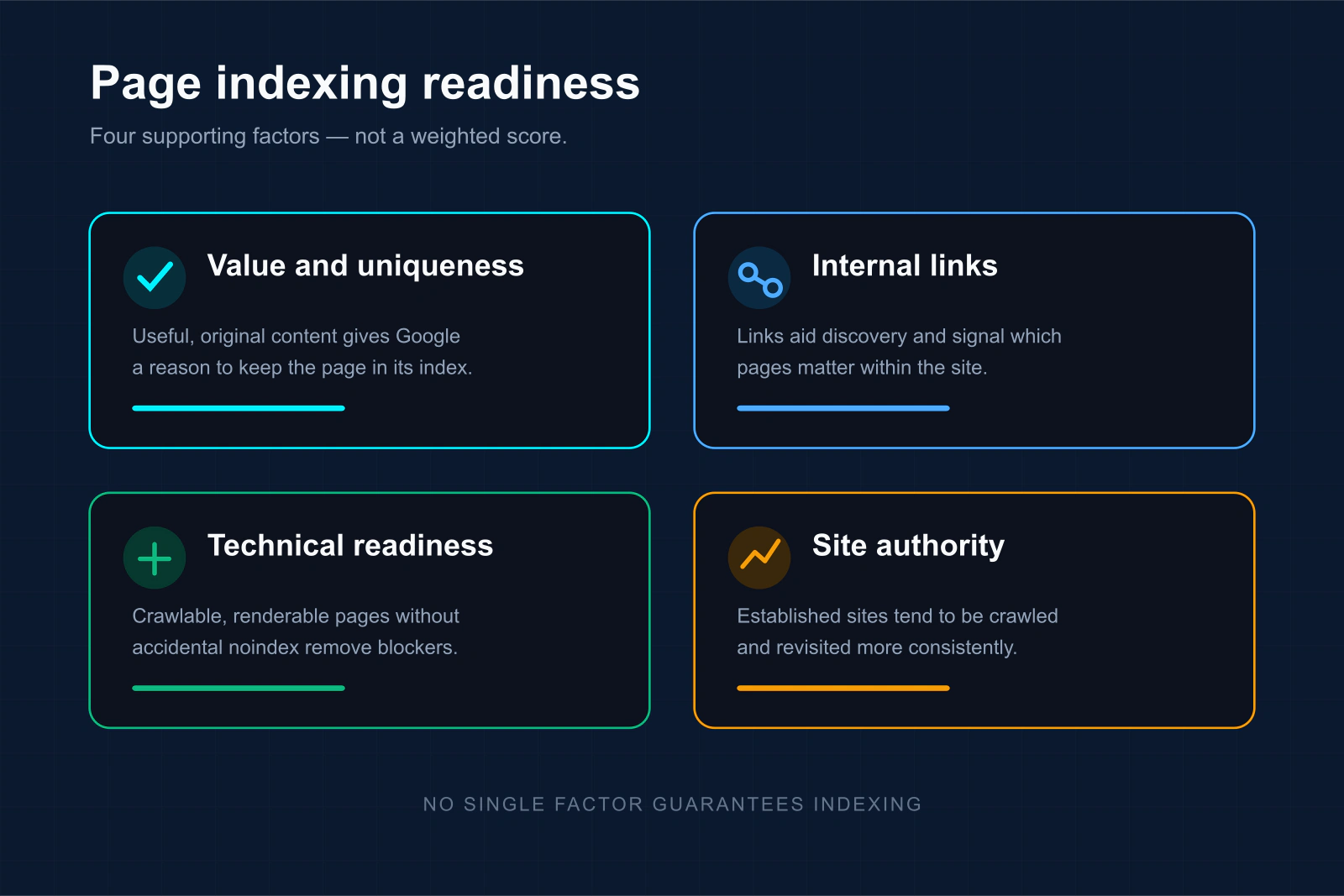
- Useful, distinct content — helps the URL provide a reason to exist apart from near-duplicates.
- Internal links from strong pages — signals importance and aids discovery.
- Clean technical setup — crawlable, no accidental noindex, fast, renders without blocked resources.
- Healthy discovery and crawl demand — internal prominence, update patterns, popularity and reliable serving can influence how Google allocates crawling.
Crawl budget, briefly
Google defines crawl budget as the set of URLs its crawling infrastructure can and wants to crawl, combining crawl capacity with crawl demand. The advanced concern primarily applies to very large, rapidly changing sites or sites with a substantial “Discovered – currently not indexed” population. That status records no completed crawl; it does not by itself prove one crawl-budget cause.
What this means for backlinks and scale
For a backlink, the hosting page controls the response, representation, directives, discovery paths and canonical signals that can be observed before an indexing decision. If you build links at scale, two things follow: (1) index rate varies a lot by link type, and (2) you have to verify indexation rather than assume it. Check large sets with a bulk index checker, and push the ones worth saving with an indexing service.
Control, observation and invalid inference by stage
| Stage | Operator-controlled input | Observable evidence | Invalid inference |
|---|---|---|---|
| Discovery | Internal links, sitemap declarations and stable URL references | Discovery/referring-page fields or a known URL in property reports | Discovered means fetched |
| Crawling | Access rules, server health, response efficiency and URL inventory | Last crawl, page fetch, crawl logs or live fetch evidence | Fetched means indexed |
| Rendering | HTML delivery, JavaScript execution and resource accessibility | Rendered HTML, screenshot, resources and console output | Live render pass predicts canonical selection |
| Indexing/canonicalization | Content purpose, directives and consistent canonical signals | Indexed result, selected canonical and dated public observation | One missing observation proves one cause |
| Serving | Relevant content and the broader signals used for a query | Actual query visibility and performance evidence | Indexed guarantees ranking |
Google’s current crawl-budget documentation defines capacity and demand separately. That distinction matters when a provider explains delay: host limits, inventory and demand are evidence branches, not interchangeable labels for “low authority.”
The indexing knowledge graph
The central entity is the URL representation. Googlebot discovers and fetches a URL; rendering produces content and links; canonical systems group duplicate representations; indexing stores a selected representation; serving evaluates that indexed representation for a query. Robots controls, HTTP responses, noindex directives, canonical hints and internal links affect different relations in this graph and should not be treated as one generic “indexing signal.”
Use the Google Search Console indexing guide to observe how discovery, crawl, canonical and indexed-report evidence map to these stages.
How does the pipeline change a provider report?
A backlink provider does not need to expose campaign-processing mechanics to report responsibly. The handoff only needs to keep the observable entities separate: submitted source URL, reachable final representation, expected link, dated index observation and—when supplied by an authorized owner—the recorded Search Console state.
| Pipeline evidence | Defensible provider statement | Owner route |
|---|---|---|
| Source not reachable | Availability and placement are unresolved at the check time | Server/access evidence |
| Source reachable; link present | Delivery was verified in the checked representation | Delivery QC |
| No indexed representation observed externally | A time-bound public observation, not a private cause | Evidence-first diagnosis |
| Alternate URL form observed | An alternate/canonical representation may carry the observable result | Canonical owner |
| Indexed representation observed | Observed at the named time and method; ranking is not implied | Tracking owner |
This is a decision framework, not a disclosure of how URLs are processed. See the public methodology for claim boundaries.
FAQ
How does Google find new pages?
Through links, sitemaps, and manual submission. Pages with no links and no sitemap entry may never be discovered.
Does Google index every page it crawls?
No. Crawling is not indexing. Directives, response behavior, rendering, duplication, canonical selection and other indexing decisions can keep a crawled URL outside the index.
Why does JavaScript matter for indexing?
Google renders JS to see the final page. If key content or links only load via JS and rendering is blocked, Google may not index that content.
How can I influence indexing?
Improve content value, add internal links, keep the page technically crawlable, and build overall site authority.