Part of the Indexing Basics topic guide. Use the guide to move from this specific question to the full diagnostic workflow.
Crawling is Google fetching your page. Indexing is Google storing it. Ranking is Google ordering it against competitors for a query. They happen in that order, and each is a separate gate — a page can be crawled but not indexed, or indexed but not ranking. Knowing which stage is failing tells you exactly what to fix.
This crawl–index–serve distinction is the starting relation in the Indexing Basics knowledge path; use the specialist owners only after the first failed stage is identified.
The three stages, defined
- Crawling — Googlebot requests the URL and downloads its content (then renders JavaScript). Question: can Google reach and read it?
- Indexing — Google analyzes the crawled page and decides whether to store it in the index. Question: is it worth keeping?
- Ranking — for a given search, Google selects and orders indexed pages. Question: how good is it compared to others?
Side by side
| Crawling | Indexing | Ranking | |
|---|---|---|---|
| What it is | Fetching the page | Storing the page | Ordering pages for a query |
| Can fail because | robots.txt block, no links, server errors | thin/duplicate content, noindex | weak content, low authority, competition |
| Where to check | URL Inspection: “Crawl allowed / Page fetch” | URL Inspection: “Indexing allowed / on Google” | Search Console Performance / SERP position |
Why the distinction matters
Most “my page isn’t showing up” problems are actually a specific stage failing. Fixing the wrong stage wastes time — improving content won’t help a page blocked by robots.txt, and requesting indexing won’t help a page Google never crawled because it’s an orphan.
How to tell which stage is failing
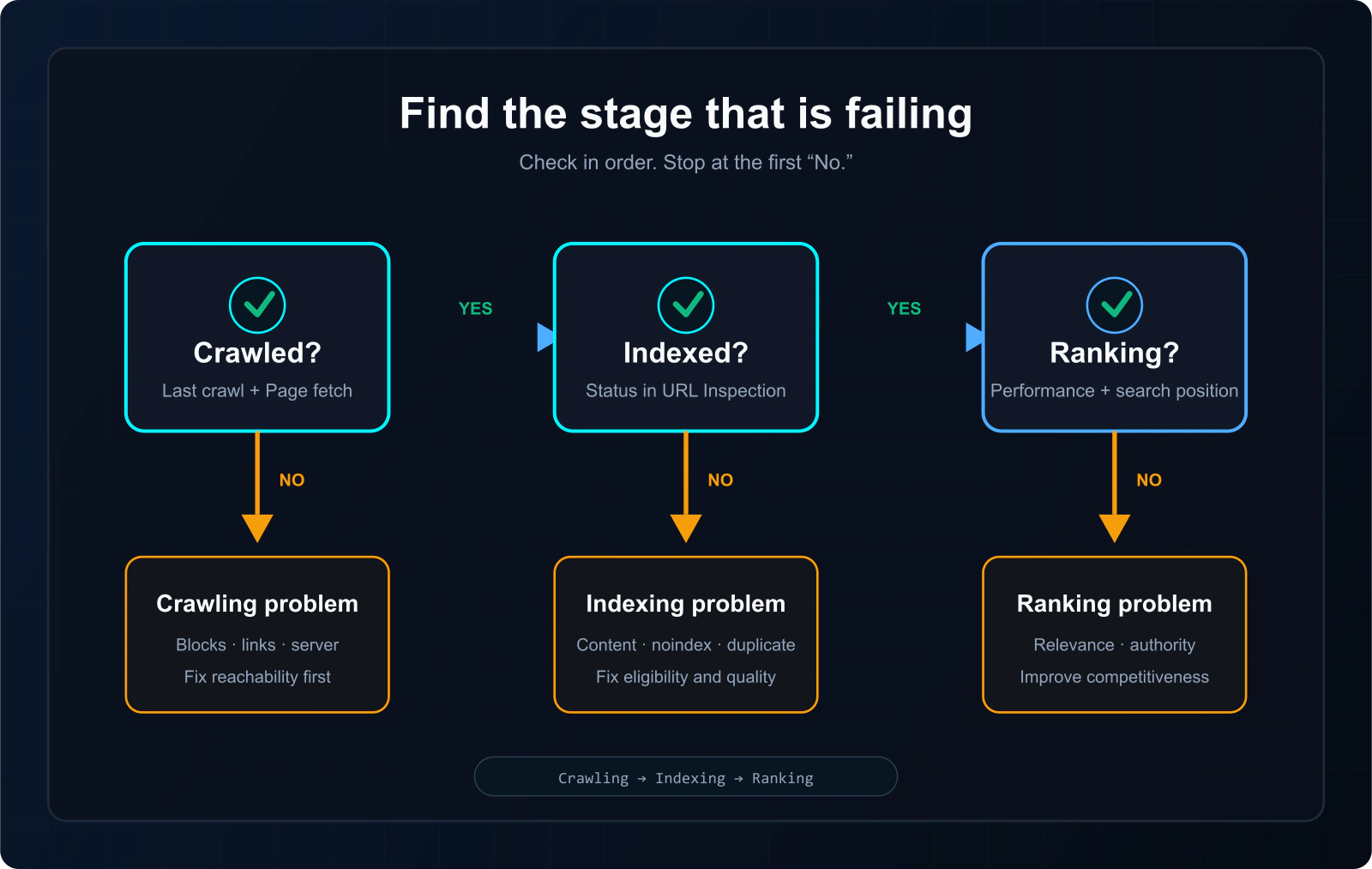
- Crawled? In the URL Inspection tool, check “Last crawl” and “Page fetch”. No crawl or a failed fetch = a crawling problem (blocks, no internal links, server errors).
- Fetched? Separate “Discovered – currently not indexed,” where no completed crawl is recorded, from “Crawled – currently not indexed,” where a crawl is recorded but the URL is not currently indexed.
- Indexed? Check the recorded indexing state and canonical details. A completed fetch does not by itself establish index storage.
- Ranking? Indexed but no traffic = a ranking problem, not an indexing one. That’s a content/authority issue, not this article’s scope.
n
For URLs outside your Search Console property — like backlinks — use a bulk index checker to see indexed status without GSC.
Fixing each stage
Crawling problems
- Remove accidental robots.txt blocks.
- Add internal links so the page isn’t orphaned.
- Fix server errors and slow responses.
Indexing problems
- Improve thin or duplicate content so the page earns its place.
- Remove stray
noindextags. - Consolidate duplicates with a canonical (see duplicate canonical).
- Details: Crawled – currently not indexed.
Where backlinks fit
A backlink can only be verified as an indexed search result once the page holding it is indexed. Many links get crawled and stop there — crawled, never indexed, so their contribution can’t be confirmed (which isn’t the same as proving it’s zero). If you build or sell links, checking the indexing stage of each link is the difference between demonstrable value and budget you can’t account for.
A provider-facing misdiagnosis matrix
| Evidence available | Defensible statement | Do not claim | Next action |
|---|---|---|---|
| Source URL fails or redirects unexpectedly | Availability or delivery could not be verified at the check time | Google rejected the page for quality | Resolve the source response and expected-link state first |
| Search Console records discovery but no completed crawl | The property report has not recorded a completed fetch | The page was crawled and rejected | Review discovery, internal prominence, host health and crawl demand |
| Search Console records a crawl but no indexed selection | The page was fetched but is not currently selected for indexing | One specific cause without supporting evidence | Review rendered content, directives, duplication and canonical signals |
| Third-party URL is not observed externally | No indexed representation was observed by that method and time | A private Search Console status or zero link value | Keep the outcome unresolved and investigate only publicly observable gates |
| Indexed representation exists but target query has no visibility | The issue is downstream of index eligibility | That indexing failed | Move the investigation to relevance, competition and ranking evidence |
This matrix is the operational difference between state classification and cause diagnosis. A backlink seller can report the state that was observed; a cause requires the additional evidence shown in the same row.
The entity relationship that prevents bad diagnoses
Discovery → crawl scheduling → fetch → render → canonical selection → is a sequence, not a set of synonyms. A crawl
index storage → serving
confirms retrieval; indexing confirms storage of a selected representation;
serving depends on the query and other systems. A failure at one node changes the
next diagnostic action.
Track at least: discovered URL, fetched URL, HTTP response, rendered content,
user-declared canonical, Google-selected canonical, observation method, and
observation time.
Which owner guide should you open next?
| First failed relation | Owner guide | Why this route is narrower |
|---|---|---|
| URL is known but no completed crawl is recorded | Discovered—currently not indexed | Owns discovery and crawl-scheduling evidence |
| Fetch fails, is denied or is unstable | Server and access errors | Owns HTTP, timeout, DNS and access evidence |
| Fetch succeeds but the response resembles a missing page | Soft 404 | Owns response/content mismatch |
| An alternate representation is selected | Duplicate canonical diagnosis | Owns canonical-cluster decisions |
| An indexed representation exists but visibility is weak | Ranking investigation | Stops the indexing workflow at its correct boundary |
For backlink providers, the same sequence becomes a reporting rule: verify delivery and availability first, attach a dated index observation second, and name a Search Console state only when the property owner has supplied authorized evidence. See the IndexVero methodology for the public evidence boundary.
FAQ
Can a page be crawled but not indexed?
Yes — that’s exactly what “Crawled – currently not indexed” means. Google fetched it but chose not to store it.
Does indexing guarantee ranking?
No. Indexing makes a page eligible; ranking depends on quality, relevance, and competition.
Which comes first?
In organic search the standard pipeline is crawling, then indexing, then ranking: a page must have an indexed representation before it can be evaluated for organic ranking. (Paid placements and some other surfaces don’t depend on this organic index.)
If the URLs you need indexed are backlinks on sites you don’t control, Search Console can’t submit them for you. Our backlink indexing service handles third-party URLs in bulk and verifies the outcome.