Part of the Indexing Problems topic guide. Use the guide to move from this specific question to the full diagnostic workflow.
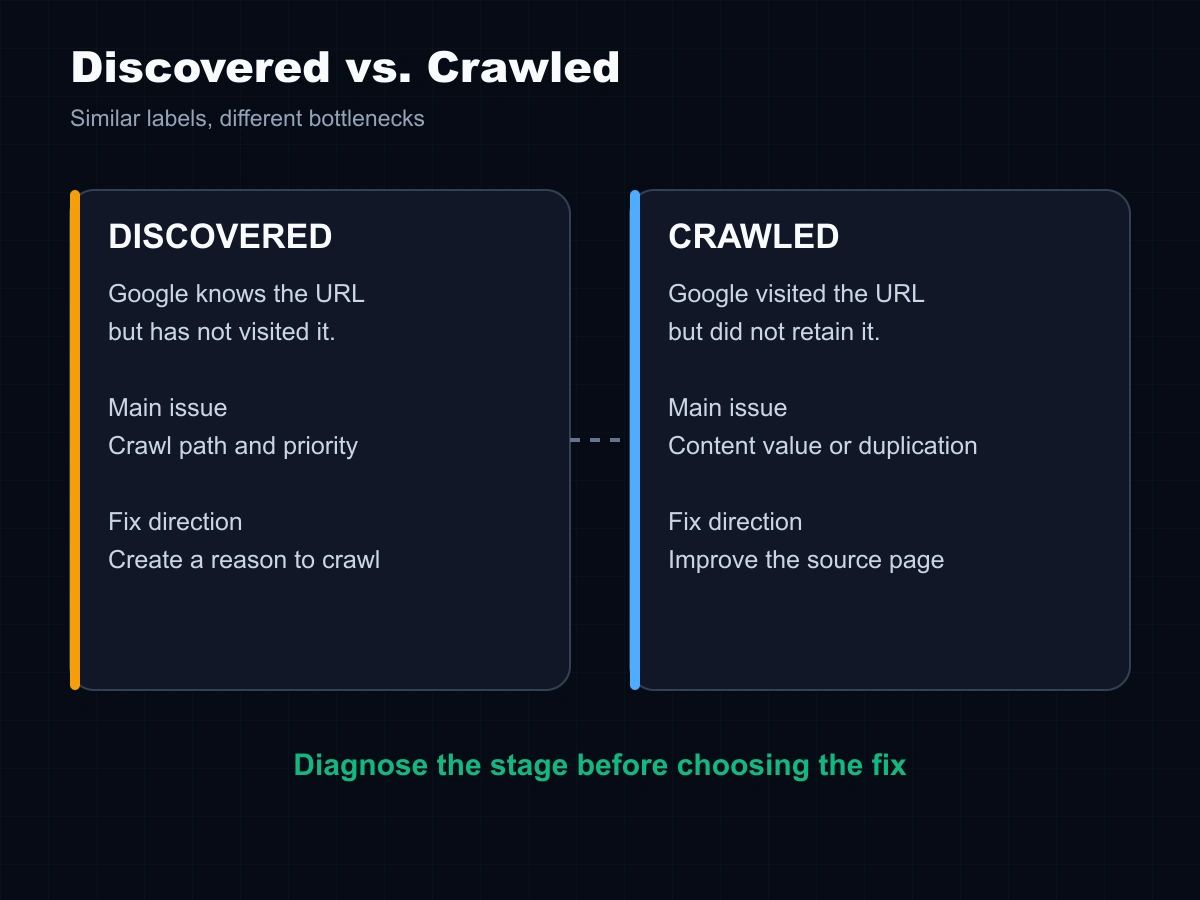
“Discovered – currently not indexed” means Google’s report shows it knows your URL exists (it found it via a sitemap or link) but has no recorded crawl for it yet — so it isn’t indexed. It’s different from “Crawled – currently not indexed,” where the report records a completed crawl but no current indexed selection. For a backlink, this status means Google has not recorded a crawl of the source page; that observation alone doesn’t prove the link is worthless — common contributing factors are limited crawl budget or a low-priority source, which you then investigate.
Place this discovery state within the indexing-state diagnostic library before choosing an availability, crawl, canonical or content investigation.
Discovered vs Crawled — don’t confuse them
They describe different recorded states, but neither label proves one root cause:
| Discovered – not indexed | Crawled – not indexed | |
|---|---|---|
| Has Google crawled it? | No | Yes |
| Recorded distinction | No completed crawl is recorded | A completed crawl is recorded, but the URL is not currently indexed |
| Investigation direction | Discovery paths, internal prominence, sitemap, availability and crawl evidence | Rendered content, directives, response, duplication, canonical signals and changes since crawl |
Start with what "indexed" actually means so discovery, crawling and indexed selection are not collapsed into one status.
Why hasn’t Google crawled it?
- Site-wide crawl pattern — compare whether the state affects many URLs and whether the host is stable.
- Few or no internal links to the page — hard to find, low priority.
- Weak discovery or prominence evidence — verify crawlable internal paths rather than inferring authority from the label.
- Sometimes it’s just new and needs time.
Review where discovery sits in the indexing pipeline before deciding which discovery or scheduling evidence to investigate.
What it means for your backlink
A backlink stuck in “Discovered – not indexed” means Google hasn’t recorded a crawl of the page holding your link, so the link can’t be verified as contributing yet — that isn’t proof its value is zero, but you can’t count on it until the page is crawled and indexed. It is a reason to inspect the source page and its discovery evidence, not proof that the source is weak. Before spending effort, check the whole batch to see how many links are stuck.
How to fix it
- Create legitimate discovery paths: add relevant crawlable internal links when you control the source property.
- Sitemap: make sure the URL is included — it aids discovery (not indexing).
- Choose an operational next step only after the evidence shows the URL is reachable, eligible and worth processing; an indexing service cannot override Google’s decision.
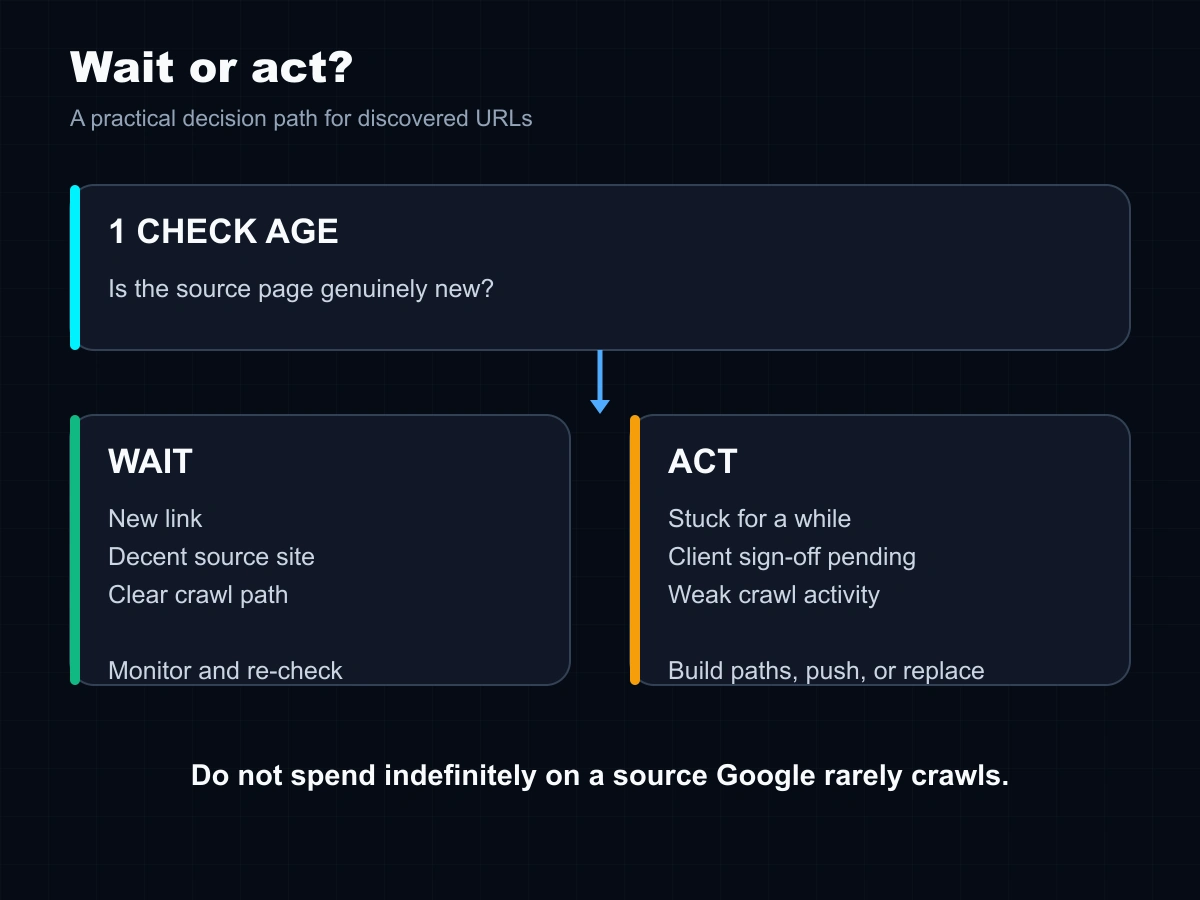
- If the source site barely gets crawled at all, change sources — don’t force it.
Wait or act?
- Monitor a genuinely new URL when discovery and availability evidence are healthy, using a dated recheck rather than a promised deadline.
- Act if it’s been sitting a while, or the batch is in a package awaiting client sign-off.
A safer diagnosis graph
The status establishes two facts: Google knows the URL and the indexed report does not show a completed crawl for it. It does not by itself prove “low authority,” thin content, or a specific crawl-budget problem.
- Confirm the status and last report date in Search Console.
- Check whether the URL is reachable through crawlable internal links.
- Compare sitemap inclusion, canonical target, response status and robots rules.
- Separate a site-wide pattern from a single-URL exception.
- After changes, use a live test, then preserve the next indexed observation date.
What can a backlink provider prove without property access?
An external observation cannot prove that a third-party source URL has the private Search Console state “Discovered—currently not indexed.” A provider can prove the source response, final URL, visible directives, link presence and a dated external index observation. The named Search Console state requires authorized evidence from the source-property owner.
| Evidence | Supported statement | Unsupported leap |
|---|---|---|
| Authorized report shows discovery and no recorded crawl | The property records the discovered state at that report time | One guaranteed crawl-budget or quality cause |
| External check does not observe an indexed representation | No indexed URL form was observed by that method and time | The private Search Console state |
| Source has no crawlable internal path | A discovery/prominence weakness is observable | That this alone caused Google’s recorded state |
| Source is unavailable or denied | Fetch and placement verification are unresolved | A content-quality rejection |
Provider escalation record: source URL, final URL, response class, expected link, link-presence result, visible robots/canonical signals, observation method, timestamp and the owner-only field needed next. Route unavailable responses to the server/access owner, and use the Indexing Problems hub for other states.
The IndexVero methodology explains why campaign processing, a public observation and an authorized Search Console state remain separate evidence objects.
FAQ
How is “Discovered” different from “Crawled” not indexed?
Discovered = not crawled yet; Crawled = crawled but not indexed.
Does Request Indexing help?
It asks Google to revisit an eligible URL; it does not guarantee a crawl or indexed selection and does not repair underlying issues.
Will it fix itself?
There is no guaranteed outcome or timeframe. Recheck after supported changes and preserve the observation date.
If the URLs you need indexed are backlinks on sites you don’t control, Search Console can’t submit them for you. Our backlink indexing service handles third-party URLs in bulk and verifies the outcome.