Part of the Backlink Indexing topic guide. Use the guide to move from this specific question to the full diagnostic workflow.
A backlink on a source page that is not observed indexed cannot be verified as part of Google’s searchable index. Treat it as an unresolved delivery outcome, not proof of zero ranking value. The cause is rarely a “wrong anchor” — it’s a source page that’s too weak, hasn’t been crawled, or was crawled and dropped. This guide shows how to tell which links are worth indexing, which to skip, and how to prove it to a client.
Start the provider investigation in the backlink indexing diagnostic workflow, then route each source URL by availability, placement and observation evidence.
You spend money building a batch of links. Weeks later the client asks why rankings haven’t moved — and the truth is Google hasn’t even looked at a big chunk of them. Before you spend more credits, read this.
An unindexed link can’t be verified as working
Index status is evidence about whether Google stored a source-page representation, not a direct measurement of link equity or ranking impact. If the page is not observed indexed, report the backlink as unverified and investigate discovery, crawlability, canonicalization, content, and availability. The problem: the share of links that never index is far higher than most SEOs assume.
Why they don’t index
Skip the textbook reasons — here’s what actually happens with backlinks:
- Google hasn’t crawled the source page — it’s orphaned, with no path for Googlebot. (GSC: “Discovered – currently not indexed.”)
- Crawled but dropped — the source page is too thin or generic. (GSC: “Crawled – currently not indexed”.)
- Low source authority — if the whole domain is barely indexed, a new page sinks too.
- Duplicate / thin — a guest post written only to place a link, with no standalone value.
- Spam history — an overused PBN, automated Web 2.0 property, or mass-submission directory may have accumulated too many thin and spammy URLs.
- The submitted URL is only a fragment — a blog comment’s
#commentanchor points to a position on the original article; it is not a separate URL for Google to index.
Notice none of this is about how you set the anchor or target — it’s about the quality and standing of the source page.
Which links are worth saving?
This is where you save credits. Ranked by how salvageable they are:
| Link type | Worth indexing? | Why |
|---|---|---|
| Editorial guest post (strong site) | Very much | High authority — one nudge and it indexes |
| Forum thread with traffic | Yes | “Alive” page, crawled often |
| Established Web 2.0 platform (Google Sites, Blogger, WordPress.com) | Yes | Large platforms receive traffic and are crawled frequently; useful public pages often index naturally |
| Automated Web 2.0 blog (RankerX, SEO Autopilot, similar tools) | Usually skip | Mass-created sites are very hard to index unless rebuilt with unique content and genuine signals |
| New or clean PBN | Often | A property without a spam history can initially be crawled and indexed easily |
| Aged or overused PBN with many spam URLs | Usually skip / high risk | Heavy spam can erode trust and lead to deindexing or penalties |
| Citation / directory | Selective only | Many directories have been heavily spammed; save only reputable, useful listings |
| Blog comment | Check the source URL | The article may already be indexed, but its #comment fragment cannot be indexed separately |
| Social profile | Yes | Established social platforms have traffic and frequent crawling; complete public profiles often self-index |
| Google Chrome / Chrome Web Store listing | Sometimes | Medium difficulty; results vary with listing quality, demand, and external mentions |
| Mozilla Firefox Add-ons listing | Low priority | Harder to index because discovery demand and crawl frequency can be lower |
| Podcast link | Sometimes | Medium difficulty; value depends on the platform and the quality of the episode or show-notes page |
The rule: don’t spread credits evenly — inspect the source first, and concentrate effort on links that are actually worth it. Prioritize strong editorial pages, active forums, genuine social profiles, useful pages on established Web 2.0 platforms, and clean sources. Avoid repeatedly pushing automated properties, mass-spammed directories, and overused PBNs. For comments, check the original article URL instead of the #comment fragment. See the full backlink indexing difficulty guide for a side-by-side comparison.
Start by checking whether the source page is technically eligible: check whether the source page blocks indexing before spending another campaign credit.
How to see where the whole batch stands
Don’t check site: one URL at a time. Use a bulk index checker to split the batch into Indexed / Not indexed / Pending in one pass, then decide what to save. Want to be sure links are still live (not removed)? Verify the list first.
Pushing the ones worth saving
- Create a path for Googlebot: internal links from a strong page on the source, or share the source URL where Google crawls often (X, Reddit).
- Thicken the source content if you control it.
- For volume, submit them for bulk indexing instead of manual requests — but be wary of any service promising “100% indexing,” because no one can force Google. Use a measured cohort rate with its denominator, observation method, and check date; do not publish a generalized success-rate promise.
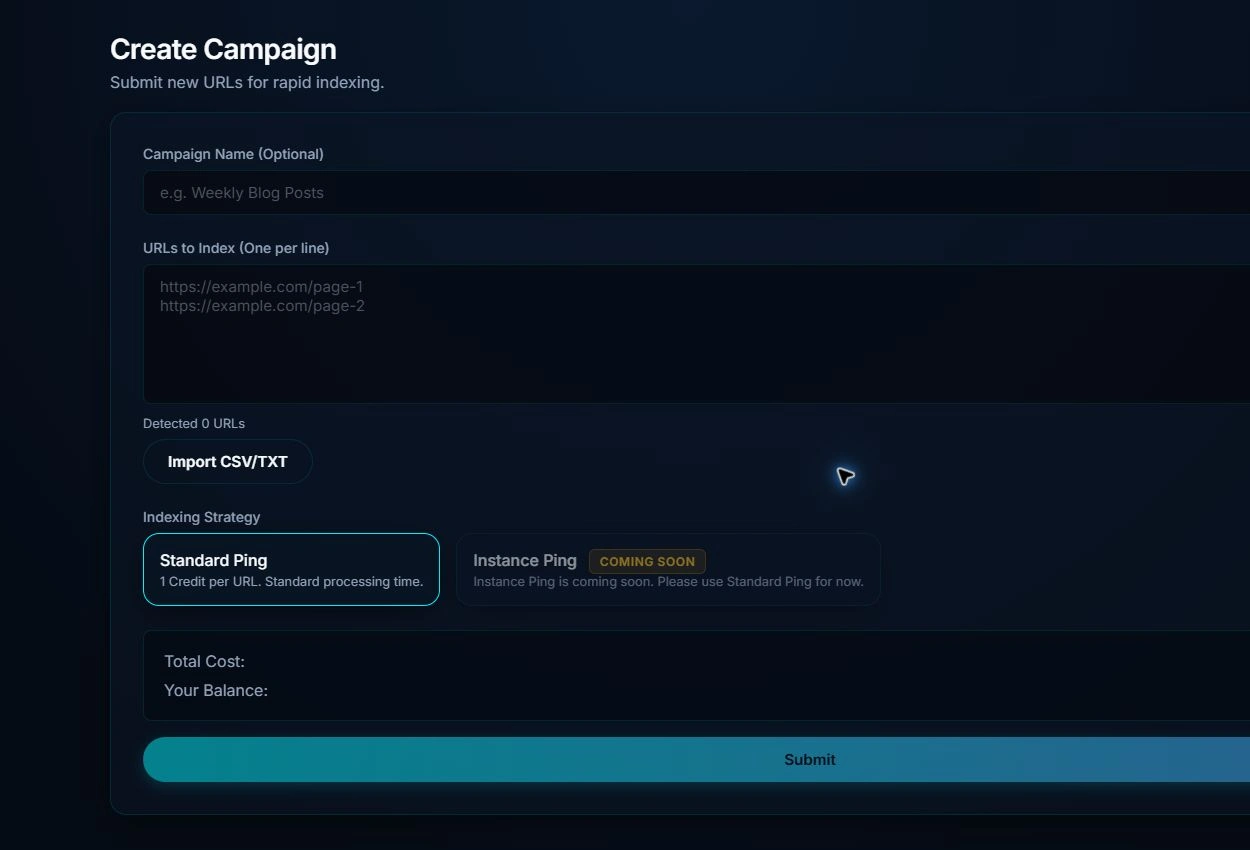
Before committing the remaining batch, apply how to choose a backlink indexer to match the service to the evidence and recheck workflow you actually need.
Proving it to a client
Whether a link indexed is easy to argue about at sign-off. Keep it clean: export a per-URL status list with the check date, sign off the indexed portion, and track the rest. Transparency about the real rate always beats a 100% promise everyone knows is fake. (See how to prove index rate to clients.)
What the first-party observation baseline actually says
Across 472,845 URLs checked between 3 July and 24 August 2026, IndexVero observed 52.70% as indexed. The match-type split has not been recomputed for that period; the most recent split available is the earlier July 2026 sample of 166,988 dated index observations, in which IndexVero observed 65,148 exact-URL indexed matches and 15,416 alternate/canonical-form matches, while the remaining 86,424 were not observed indexed using the configured checker at that time. The combined observed-indexed share of that earlier sample was 48.25%.
Definitions, denominator rules and limitations for this aggregate sample are documented in the IndexVero measurement methodology.
This is not an “IndexVero success rate” and does not establish why a URL was missing. The population was mixed and self-selected. Use it as evidence that verification and canonical-aware matching matter—not as a forecast for a new campaign.
FAQ
Does an unindexed backlink count?
Not necessarily. A missing index observation is not a direct measurement of ranking value; report the source page, link-presence check, method, and date separately.
How long until a backlink indexes?
Google provides no guaranteed crawl or indexing timeline. Record the observation date and recheck with the same method.
Should I buy an indexer that promises 100%?
Be skeptical. No tool can force Google; real rates vary widely with link quality.
Do nofollow links get indexed?
They can — index status is independent of the rel attribute, as long as the page has value.