Part of the Backlink Indexing topic guide. Use the guide to move from this specific question to the full diagnostic workflow.
Don’t hand off with “they’re all indexed.” Export a per-URL status list with check dates and a real index rate — evidence the client can verify. Being transparent about the true rate (even when it’s below 100%) closes payment faster than a 100% promise everyone knows is fake.
Client proof is the final state in the provider backlink-indexing workflow, after delivery, reachability, link verification and dated observation have been recorded separately.
Why this is where money leaks
A “delivered” backlink that the client checks and finds unindexed is the number-one cause of sign-off disputes, delayed payment, and refund requests. The issue usually isn’t poor work — it’s that you have no evidence the client trusts.
The 4-step proof workflow
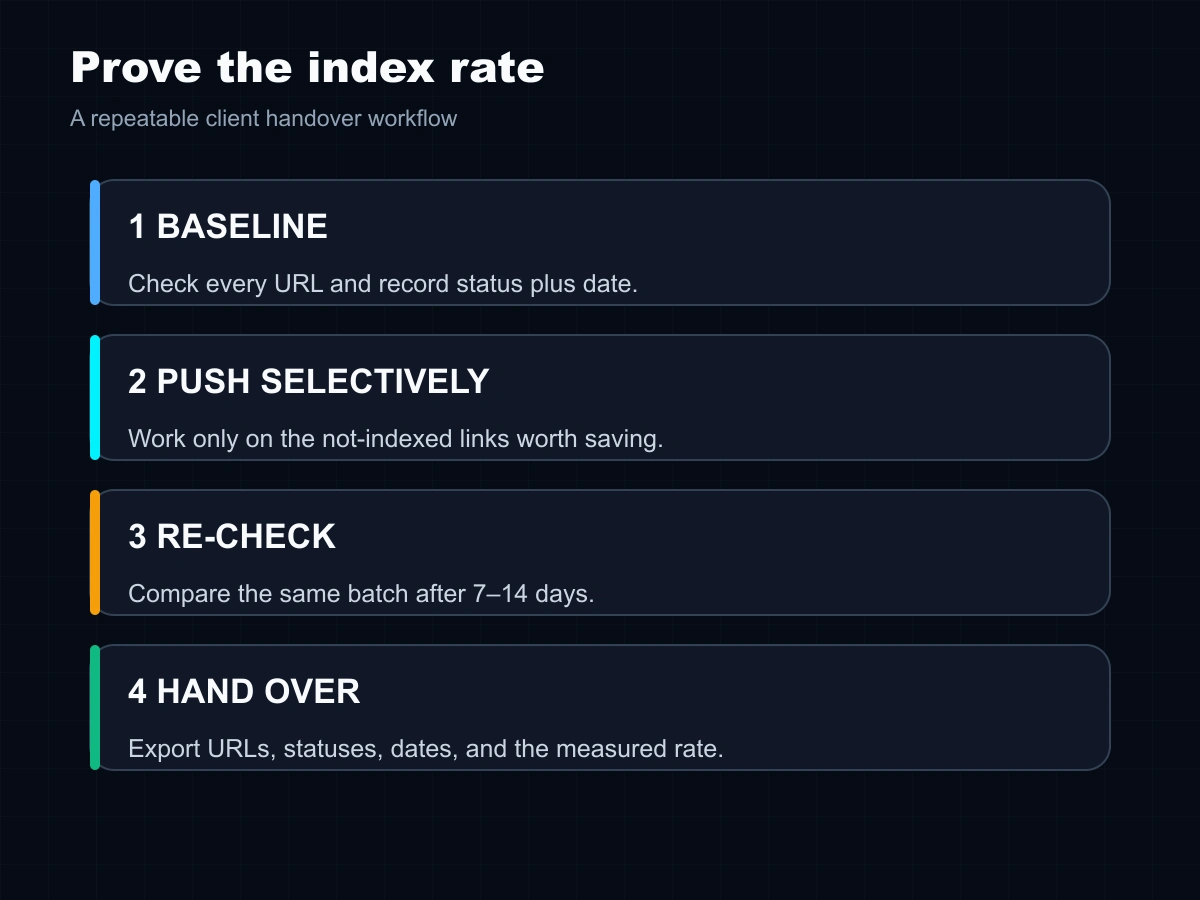
- Baseline right after building: check the batch’s index status and record Indexed / Not / Pending with the date.
- Push the not-indexed set: index the ones worth saving.
- Re-check on a schedule: after 7–14 days, update statuses and compute the index rate = indexed / total.
- Export a handover report: URLs + statuses + dates + index rate. Sign off what’s achieved; note what’s still tracking.
Run an availability check before you report so unreachable sources do not get mistaken for valid negative index observations.
Why “honest” beats “100%”
No tool can force Google to index 100% — experienced clients know that. A report that says “82% indexed as of March 3, remaining pushed and tracking” is more credible than a flat 100% claim. That transparency is exactly what keeps clients coming back.
Use realistic indexing timelines to explain why a dated observation is defensible and a universal guarantee is not.
A minimum report format
- Columns: URL · Status · Check date · (optional) link type.
- Summary row: index rate + the date it was measured.
- Notes on what you did with the not-indexed links.
Define what "indexed" means in a provider report before presenting the numerator, denominator or result classes.
A report schema a client can audit
At minimum, disclose: eligible denominator, submitted count, check method, check date, exact indexed matches, alternate/canonical matches, not-observed items, unavailable checks and excluded URLs. IndexVero’s aggregate used these distinctions across 472,845 URLs checked between 3 July and 24 August 2026; 52.70% were observed indexed when exact and alternate matches were combined.
That 52.70% is a mixed historical baseline, not a customer forecast. A client report must calculate its own cohort and preserve its own denominator.
Use the IndexVero measurement methodology when defining the denominator, exact and alternate observations, unavailable checks and recheck window in a client report.
FAQ
What index rate should I commit to?
Commit to the real rate you typically hit — not 100%.
What if the client demands 100%?
Explain that no one can force Google to index; propose a real-rate model with tracking of the remainder.
How often should I re-check?
Use the interval defined in the delivery agreement and record it in the report; there is no universal recheck schedule.